
How to Pray for Others Without Turning Their Needs Into Gossip
Build a manageable prayer list, protect people's confidence, and connect intercession with thoughtful follow-up.
Revised 2026-11-04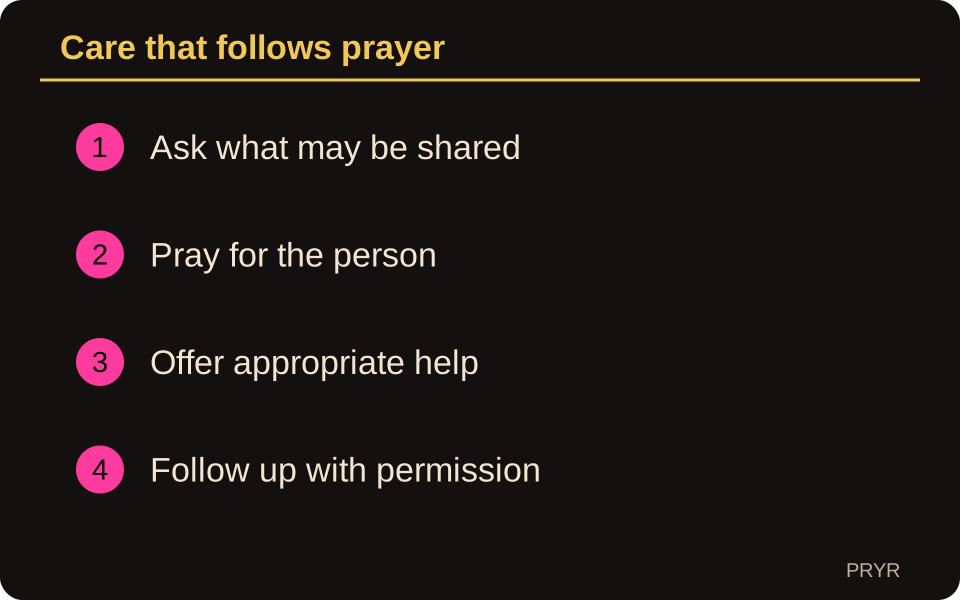
Start with a person, not a report
A friend tells you about a difficult situation, and you want other people to pray. Before forwarding the message, pause. The fact that a need has been shared with you does not mean it has been shared with your group. A prayer request can contain medical information, family conflict, financial details, or another person's story. Caring about the person includes caring about who gets to know those things.
The historic prayer for friends and relations asks for mercy and for a shared life shaped by God's love. The prayer for rulers extends concern beyond our immediate circle. Together they offer a useful breadth: pray for the people personally entrusted to you, and remember those whose decisions affect many others. Neither requires collecting every detail before prayer is possible. You can intercede faithfully with limited information.
Ask what may be shared
Use a direct, unhurried question: Would you like me to keep this between us, or may I ask our prayer team to pray? If they agree to sharing, clarify whether their name and the details are included. Permission to tell one pastor is not automatically permission to send a group message or display a request publicly. When in doubt, share less and ask again rather than assuming that a good intention settles the matter.
Help them write a short version if they want one. Please pray for wisdom during a difficult family decision may be enough. Avoid adding a diagnosis, suspected motive, or dramatic description they did not provide. If the request concerns someone who has not consented, remove identifying details where possible. An anonymous label does not protect privacy if the circumstances make the person obvious to everyone reading.
Keep a list small enough to use
A prayer list should support attention rather than become an expanding record of distress. Try keeping a few current requests with the person's preferred name, the wording they approved, and a date to check back. If you keep digital notes, use appropriate access controls and do not copy sensitive information into unnecessary places. A paper notebook also needs care if it can be read by other people in your home or workplace.
Separate a recurring concern from a dated event. A surgery on Thursday may need a reminder that morning and a later check-in. A long season of caregiving may need ongoing prayer without daily requests for news. Review the list regularly and remove information that no longer needs to be kept. The goal is faithful remembrance, not the permanent accumulation of private histories you have no reason to retain.
Pray for their good, not your preferred script
Name the need as honestly as you can, and leave room for the person's own hopes and choices. Ask for healing, provision, courage, reconciliation, or wise counsel without claiming that you know exactly what will happen. If you disagree with a person's decision, do not use a public prayer to argue with them indirectly. Conversation and counsel should be offered openly rather than smuggled into words addressed to God.
Broaden intercession beyond people who are easy to love. The prayer attributed to Clement asks for public leaders to govern well. You can pray for justice, restraint, wise judgment, and the welfare of those affected by their decisions without endorsing every action they take. Let the language remain specific enough to mean something and generous enough not to become a partisan speech delivered under the cover of devotion.
Make one appropriate offer of help
Sometimes the next faithful response is a practical one. If a person is overwhelmed, offer a defined task: an hour of childcare, a ride, or a meal on a particular evening. Ask rather than taking over. Someone receiving care still has preferences, boundaries, and the right to decline. Prayer does not authorize you to become the manager of their circumstances or to recruit helpers without their agreement.
Follow up gently: I remembered your appointment today. No pressure to reply, but I am thinking of you. Avoid asking for outcomes as though the person owes you evidence that prayer worked. If they share good news, ask before passing it on. If the news is difficult, resist withdrawing because you do not have a satisfying answer. Continued presence may be especially valuable when the situation remains unresolved.
A weekly rhythm for intercession
Set aside a short weekly review rather than relying on memory alone. Pray for current requests, notice any promised follow-up, and include one concern beyond your personal network. You could remember local schools, caregivers, people displaced from home, or those responsible for public decisions. Keep the practice grounded in people and responsibilities, not an obligation to carry every crisis in the world at once.
This original prayer can close the review: Loving God, remember the people whose needs I have heard and those I have overlooked. Give them the help that is truly good for them. Teach me to protect their confidence, listen without controlling, and act when I can serve. Bless those who carry public responsibilities with wisdom and concern for the vulnerable. Make my remembrance faithful, even when I have little to say. Amen.