
A Five-Minute Morning Prayer That Connects Faith to Your Day
Begin with gratitude, name the day ahead, and choose one concrete act of faithfulness—with a short prayer for mornings that do not go to plan.
Revised 2026-11-04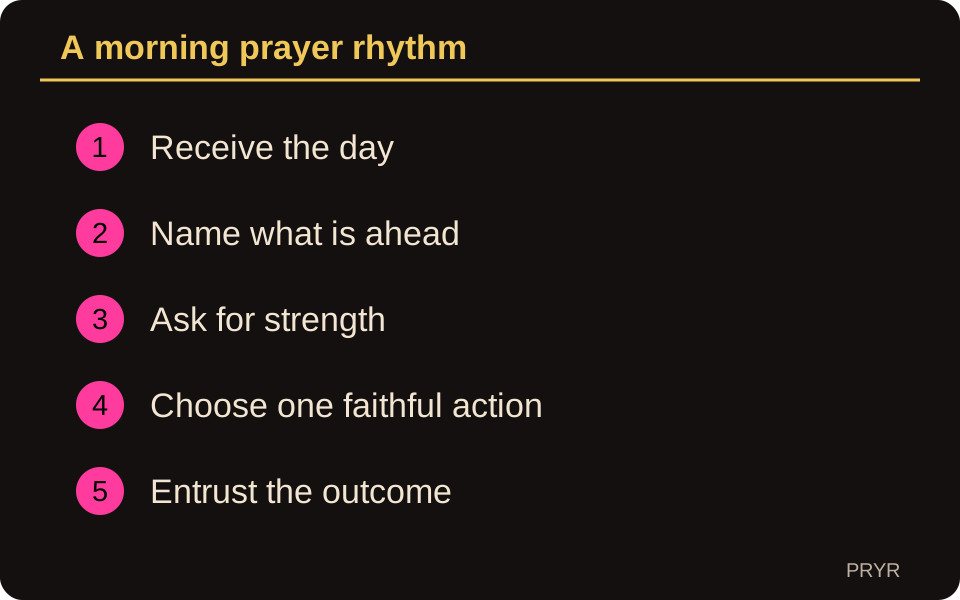
Start where you are, not where you wish you were
The alarm has sounded, somebody needs breakfast, and your mind is already rehearsing an uncomfortable conversation. A morning prayer does not require you to escape that situation. It gives you a way to bring it before God. You can pray sitting on the edge of the bed, beside the kettle, or in a parked car before work. Choose a place that exists in your actual routine rather than designing a morning you cannot sustain.
The ancient collect linked below asks both for knowledge of what God would have us do and for strength to do it. That pairing is useful. We often ask for a better day without considering what faithfulness inside this particular day might require. The following five-minute practice is a contemporary application of that prayer, not a historical ritual or a formula that makes the day turn out well.
Minute one: receive the day
Put the phone out of reach if you can. Take a comfortable breath and address God plainly: Father, I am here, and this day is before you. You do not have to manufacture a peaceful feeling before speaking. If you woke frightened, resentful, or exhausted, include that. Being truthful is a better beginning than pretending to possess the mood you think prayer requires.
Name one gift you can actually identify. Perhaps someone stayed with you yesterday, there is food in the kitchen, or you have another opportunity to repair a relationship. Gratitude is not a requirement to call everything good. You can thank God for a friend's kindness while still grieving the news that made that kindness necessary. Keep the gift specific enough that you know what you are thanking God for.
Minutes two and three: name what is ahead
Bring two or three parts of the coming day into prayer. Resist reading your entire calendar as a list of emergencies. Name the responsibility that needs attention, the person you will meet, and the uncertainty you cannot settle. For example: Help me listen before answering in the meeting. Give my daughter courage at school. Be near my father while we wait for his results.
Now distinguish a request from a responsibility. You can ask for a difficult conversation to go well, but you can also prepare to speak honestly and kindly. You can pray for enough money and still make the phone call about a payment plan. Prayer and responsible action belong together. Write down one action if it is likely to disappear under the day's demands; the note is a memory aid, not a measure of holiness.
Minute four: ask for help with your own conduct
The collect asks that our ways and doings be lived with awareness of God's presence. Apply that to a place where you are likely to struggle. Perhaps you interrupt when anxious, avoid a task because you fear criticism, or become sharp with the people closest to you. Name the pattern without turning this moment into an inventory of everything wrong with your character.
Ask for a practical alternative. Instead of merely praying to be less impatient, ask for help pausing before a reply. Instead of asking to be more generous in the abstract, identify someone you can give time to without treating them as an interruption. A small, chosen response makes the prayer available again when the situation arrives. It does not imply that every difficulty can be solved by trying harder.
Minute five: entrust what you cannot manage
Finish by acknowledging a limit. You cannot control other people's choices, make every appointment successful, or protect everyone from suffering through sufficient concentration. Entrusting the day to God is different from abandoning your duties. It means doing what is yours without pretending the rest depends on your vigilance. Leave a little silence after the words, even if that silence lasts only a few seconds.
Here is an original prayer you can adapt: God of this new morning, thank you for the life and people entrusted to me. Meet me in the work I welcome and the work I avoid. Give me wisdom to recognize my responsibilities, courage to carry them, and humility to receive help. Guard my words when I am tired. Hold those I cannot be beside today. Through Jesus Christ, amen.
When five minutes are not available
On a chaotic morning, reduce the practice rather than declaring it ruined: name one gift, one person, and one next step. On a hospital morning, gratitude may be as simple as a nurse who explained something clearly. With young children, each person can name someone to pray for while shoes are being found. These are adaptations to real limits, not lesser versions of an ideal spiritual life.
Try the same starting cue for a week. Afterward, ask whether the practice helped you remember God and respond more faithfully, not whether you maintained an impressive streak. If you missed a day, begin at the next morning. You can also return to the ancient collect itself and read it slowly, pausing at its requests for understanding and strength. The point is to carry prayer into your day, not merely to complete it before your day begins.